T-Bar Row: how to build a thick back
The t-bar row is a compound rowing exercise — you hinge over a landmine-anchored barbell and pull it to your torso to build mid-back thickness. It's a staple for a dense, detailed back.
How to do the t-bar row
- Load a barbell in a landmine (or use a T-bar machine); straddle it with your feet shoulder-width on the platform.
- Hinge forward at the hips with a flat, neutral spine — torso near parallel to the floor, knees slightly bent.
- Grip the handle (a V-handle for the mid-back, a wider grip for the lats).
- Pull the weight to your torso by driving the elbows up and back — think of your hands as hooks.
- Squeeze the shoulder blades at the top, then lower under control to a full stretch without resting the plates down.
Sets and reps
A heavy compound row — load it, but keep the spine flat and the reps clean.
| Goal | Sets | Reps |
|---|---|---|
| Strength | 3–4 | 5–8 |
| Hypertrophy | 3–4 | 8–12 |
| Endurance | 2–3 | 12–15 |
Muscles worked
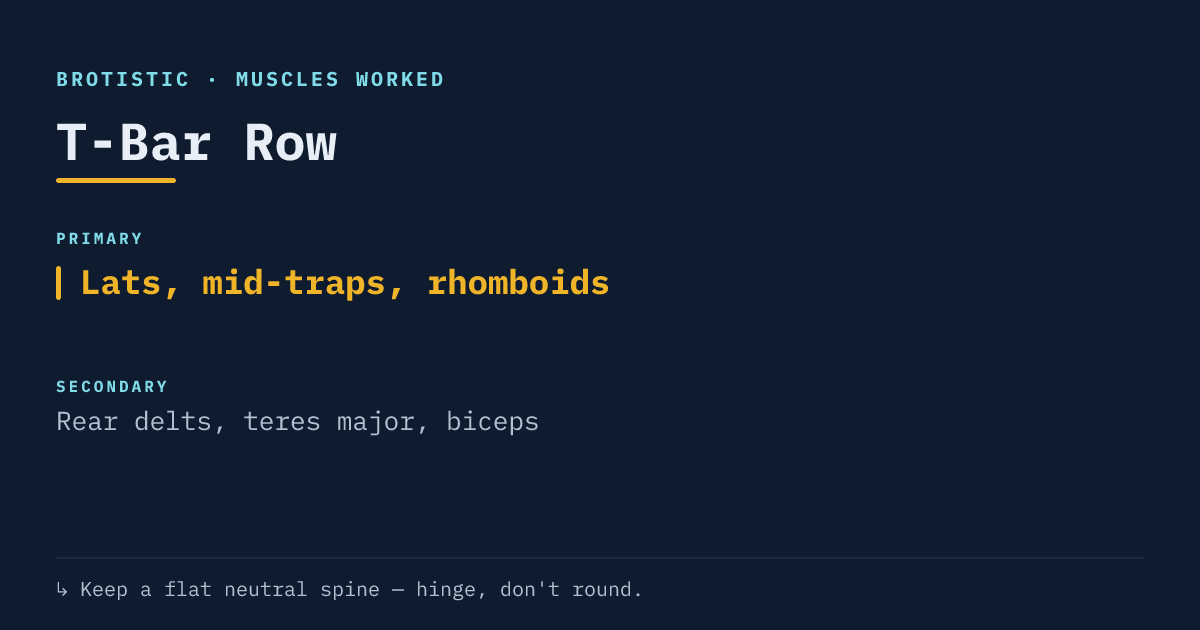
Primary — the latissimus dorsi, middle trapezius, and rhomboids.
Secondary — the teres major, rear deltoids, and biceps assist, while the erector spinae stabilises the hinge.
Common mistakes
- Rounding the lower back — the dangerous one; keep it flat and braced.
- Standing too upright — it turns the row into a shrug.
- Yanking with momentum — control the weight both ways.
- Pulling with the biceps instead of driving the elbows — lead with the elbows.
- Half reps — pull to the torso and lower to a full stretch.
Variations and alternatives
- Chest-supported t-bar row — takes the lower back out of it.
- Landmine row, dumbbell row, and the barbell bent-over row — same thickness goal, different setups.
For where it fits alongside vertical pulls for width, see the back workout guide.
Common questions
What muscles does the t-bar row work?
Mainly the lats, mid-traps, and rhomboids for back thickness, with the rear delts, teres major, and biceps assisting.
Is the t-bar row better than the barbell row?
It uses a neutral grip and a shorter range, which lets many people lift heavier with less lower-back strain. Both build the back well.
How do I stop my lower back hurting on t-bar rows?
Keep a flat neutral spine, hinge at the hips rather than rounding, and try a chest-supported version to take the lower back out of it.
What grip should I use on the t-bar row?
A narrow V-handle biases the mid-back; a wider grip shifts toward the lats.
Setting your row numbers? Work back from a recent hard set — estimate your max without testing one, or use the 1RM calculator.