Back Workout: the best exercises for width and thickness
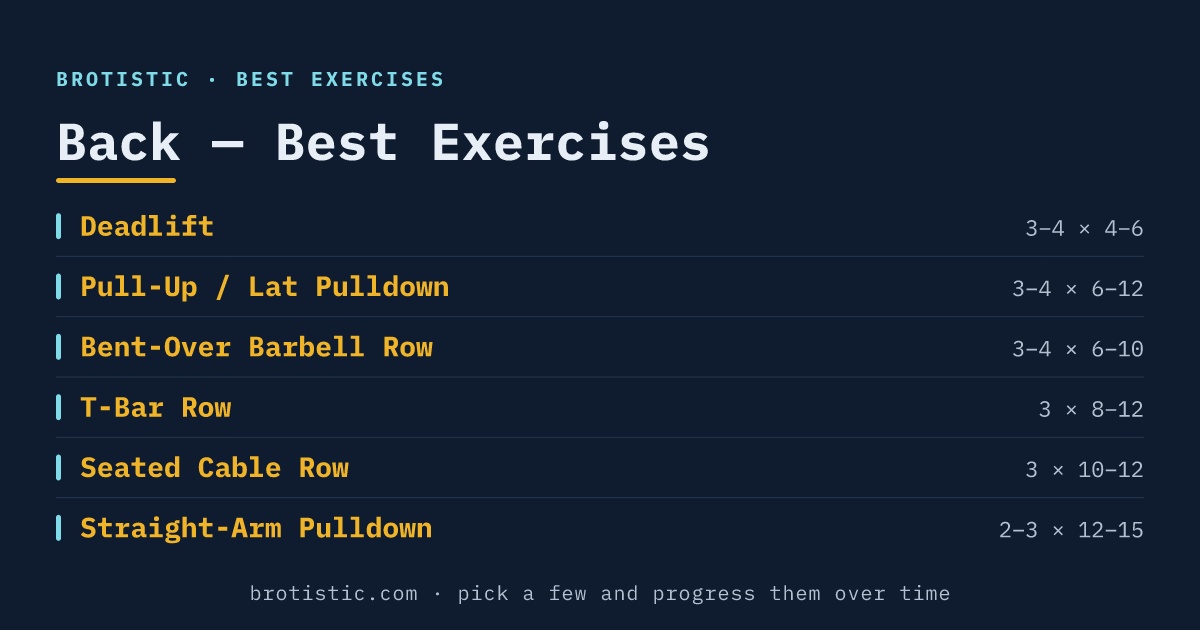
The back is several muscles — the lats (width), traps and rhomboids (thickness), and erector spinae (lower back) — trained with a mix of vertical pulls, horizontal rows, and hinges. Train one plane only and half the back gets left behind.
The best back exercises
A heavy hinge to load everything, a vertical pull for width, and horizontal rows for thickness.
| Exercise | Sets | Reps | Targets |
|---|---|---|---|
| Deadlift | 3–4 | 4–6 | Whole back + posterior chain |
| Pull-Up / Lat Pulldown | 3–4 | 6–12 | Lats (width) |
| Bent-Over Barbell Row | 3–4 | 6–10 | Mid-back thickness |
| T-Bar Row | 3 | 8–12 | Traps, rhomboids, inner lats |
| Seated Cable Row | 3 | 10–12 | Mid-back + lats |
| Straight-Arm Pulldown | 2–3 | 12–15 | Lat isolation |
A sample back workout
Four movements covering the hinge, a vertical pull for width, and two rows for thickness.
| Exercise | Sets | Reps |
|---|---|---|
| Deadlift | 3 | 4–6 |
| Pull-Up (or Lat Pulldown) | 4 | 6–12 |
| Bent-Over Barbell Row | 3 | 6–10 |
| Seated Cable Row | 3 | 10–12 |
Back anatomy
A complete back needs work in two planes — vertical for width, horizontal for thickness.
- Lats (latissimus dorsi) — the big muscles down the sides that create width. Trained by vertical pulls: pull-ups and pulldowns.
- Traps (upper/mid/lower) and rhomboids — the upper-mid back that builds thickness. Trained by horizontal rows.
- Erector spinae — the lower back, trained and stabilised by deadlifts and hinges.
The pull-up is the best single movement, and the deadlift allows the heaviest overall loading — but neither is enough alone. You need both a vertical pull and a horizontal row.
How to train back
Train back once or twice a week for around 10–18 sets across the week, balanced between vertical and horizontal pulling. Use double progression, and vary your grip to shift emphasis — wide grips bias the upper back, close or underhand grips bring in more lat.
Common mistakes
- Pulling with the arms instead of driving the elbows back and down.
- Ego-loading and using momentum to heave the weight up.
- Only doing pulldowns (no rows) — or only rows (no vertical pull).
- Not retracting the shoulder blades, so the mid-back never engages.
- Rounding the lower back on rows and deadlifts.
Common questions
What's the best back exercise?
The pull-up builds width, strength, and overall pulling power in one movement. For complete development, combine it with a heavy row and a hinge like the deadlift.
Are rows or pulldowns better?
Both — they build different things. Vertical pulls (pulldowns, pull-ups) build width through the lats; horizontal rows build thickness through the mid-back. A good back workout has both.
Is the deadlift enough for back?
No. It's an excellent overall loader for the erectors, traps, and lats, but it doesn't build lat width or mid-back detail on its own — you still need pulls and rows.
How often should I train back?
Once or twice a week works for most lifters, with around 10–18 sets across the week split between vertical pulls and horizontal rows.
Setting your deadlift and row numbers? Work back from a recent hard set — estimate your max without testing one, or run a set through the 1RM calculator to pick your working weights.