The Upper/Lower Split: a simple 4-day template
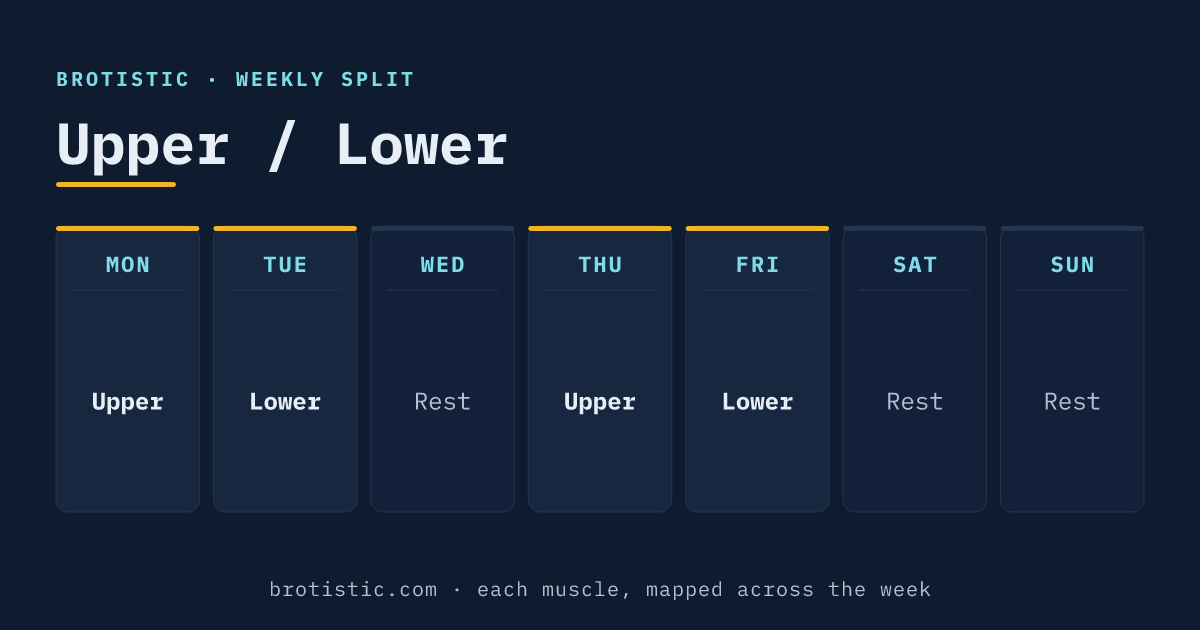
An upper/lower split alternates upper-body days and lower-body days — most often four days a week, training each half twice. It's one of the simplest structures that still hits the twice-a-week frequency that drives growth, which is why it's a default recommendation for intermediates.
It's a structure, not a fixed program, so the template below is representative — swap exercises for equivalents freely. It's also the same family as PHUL, which is an upper/lower with the two upper and two lower days split into dedicated power and hypertrophy work. If you like this layout but want heavy/light days built in, that's where to go next.
How it works
Each upper day balances pressing and pulling — horizontal and vertical, push and pull — so the front and back of your torso get equal work. Each lower day covers quads, hamstrings and calves. Running an A and a B version of each (below) means every muscle gets two slightly different stimuli per week instead of the same session twice.
The weekly schedule
| Day | Session |
|---|---|
| Monday | Upper A |
| Tuesday | Lower A |
| Wednesday | Rest |
| Thursday | Upper B |
| Friday | Lower B |
| Saturday–Sunday | Rest |
It's flexible: this is the four-day version, but the same structure stretches to six days for those who recover well. Four is the sweet spot for most.
Upper day A
| Exercise | Sets | Reps |
|---|---|---|
| Barbell Bench Press | 4 | 6–8 |
| Bent Over Row | 4 | 6–8 |
| Overhead Press | 3 | 8–12 |
| Lat Pulldown | 3 | 8–12 |
| Barbell Curl | 3 | 10–12 |
| Triceps Pushdown | 3 | 10–12 |
Lower day A
| Exercise | Sets | Reps |
|---|---|---|
| Squat | 4 | 6–8 |
| Romanian Deadlift | 3 | 8–12 |
| Leg Press | 3 | 10–15 |
| Leg Curl | 3 | 10–15 |
| Standing Calf Raise | 4 | 12–20 |
Upper day B
| Exercise | Sets | Reps |
|---|---|---|
| Incline Dumbbell Press | 4 | 8–12 |
| Seated Cable Row | 4 | 8–12 |
| Dumbbell Shoulder Press | 3 | 8–12 |
| Pull-Up | 3 | 8–12 |
| Lateral Raise | 3 | 12–20 |
| Hammer Curl | 3 | 10–15 |
Lower day B
| Exercise | Sets | Reps |
|---|---|---|
| Deadlift | 4 | 5–6 |
| Front Squat | 3 | 8–12 |
| Bulgarian Split Squat | 3 | 8–12 (per leg) |
| Leg Extension | 3 | 12–15 |
| Seated Calf Raise | 4 | 12–20 |
How to progress
Double progression on everything: top out the rep range across your sets, add weight, reset to the bottom. Because the A and B days run different exercises, you're progressing two variations of each pattern in parallel — heavier and lower-rep on the A days, a touch higher-rep on the B days.
Set your starting loads on the big lifts off a recent hard set rather than a guess — you can estimate your max without testing one.
Upper/lower, PHUL and PPL
Quick map of the neighbourhood. Upper/lower is the simple four-day base. PHUL is that base with power and hypertrophy days assigned — same four sessions, more structure. PPL is the six-day cousin that splits the upper body into push and pull for more volume per muscle. All three train each muscle twice a week; they trade simplicity against volume.
Common questions
How many days a week is an upper/lower split?
Most commonly four — two upper days and two lower days — though it can extend to six. Each half is trained twice a week.
Is upper/lower better than PPL?
Neither is strictly better. Upper/lower is four days and simpler to recover from; PPL is usually six and gives more volume per muscle. Both train each muscle twice weekly.
Is upper/lower the same as PHUL?
PHUL is a type of upper/lower — it takes the same four-day structure and assigns two days to heavy power work and two to higher-rep hypertrophy.
Can beginners use an upper/lower split?
Yes — it's one of the better intermediate-friendly structures, and a beginner with a few months of training can run it well.
Set sensible working weights before you start — run a recent set through the 1RM calculator and build your upper and lower numbers from there.