Skull Crusher: the lying triceps extension, done right
The skull crusher — the lying triceps extension — is a triceps isolation move where you lie on a bench and lower a bar to behind your head by bending only at the elbows. Done right, it's one of the best long-head builders going.
How to do the skull crusher
- Lie on a flat bench holding an EZ-bar with a shoulder-width overhand grip, arms extended over your chest/collarbone.
- Keep your upper arms steady and your elbows pointing forward — not flaring out.
- Bend at the elbows to lower the bar down and slightly behind your head — toward behind the head, not the forehead.
- Lower until you feel a full triceps stretch.
- Extend back up by squeezing the triceps, without locking out hard at the top.
Keep the upper arms still throughout; only the forearms move.
Sets and reps
An isolation move — moderate load, full stretch, controlled reps.
| Goal | Sets | Reps |
|---|---|---|
| Strength | 3 | 8–10 |
| Hypertrophy | 3–4 | 10–12 |
| Endurance | 2–3 | 12–15 |
Muscles worked
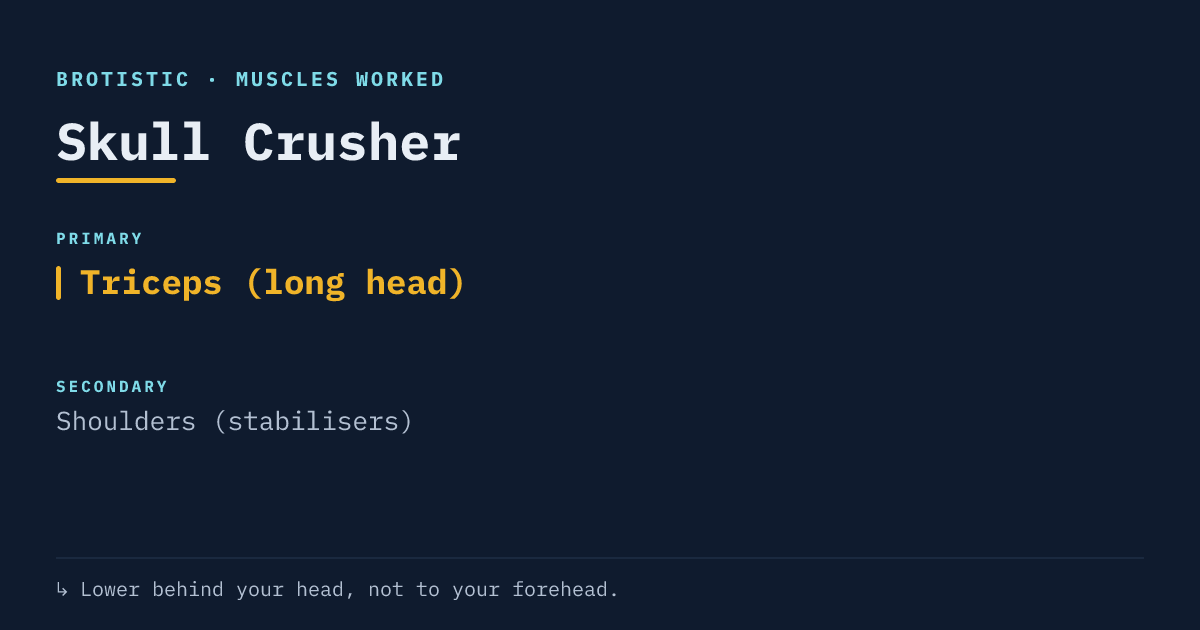
Primary — the triceps brachii, with the long head emphasised.
Secondary — the shoulders work only to stabilise the position.
Common mistakes
- Lowering to the forehead instead of behind the head — it cuts the stretch and tension.
- Flaring the elbows — keep them pointing forward and tucked in.
- Moving the upper arms or arching the torso — that turns it into a pullover.
- Going too heavy and letting the bar drop — control the eccentric.
Variations and alternatives
- Dumbbell skull crusher, cable version, and incline/decline angles.
- The overhead tricep extension is the standing cousin — same long-head bias from a different position.
For where it fits in a full session, see the triceps workout guide.
Common questions
What muscles do skull crushers work?
The triceps, with emphasis on the long head. The shoulders only stabilise.
Should I lower the bar to my forehead or behind my head?
Behind the head. It keeps tension on the triceps through a fuller stretch; lowering to the forehead shortens the range.
Why are they called skull crushers?
Because lowering the bar to your forehead with poor control is how people earned the name — which is exactly why you lower it behind the head instead.
Skull crusher vs overhead extension — which is better?
Both bias the long head. Skull crushers are done lying; overhead extensions standing or seated. Many lifters rotate between them.
Setting weights for your heavy pressing? Work back from a recent hard set — estimate your max without testing one, or use the 1RM calculator.